Response to questions from the bishops of England and Wales.

Yesterday morning, at Mass, I spotted this leaflet from the bishops of England and Wales. It includes some questions that the bishops suggest voters might ask their candidates. Here are the questions, and my answers. I can answer most of the questions. My answers nearly always refer to UKIP policy; often they refer to my own opinions and ways in which I would finesse UKIP policy or take it further. I hope that fair-minded readers, including bishops, will agree with me that UKIP is the natural home for Catholic voters like me.

LEAVING THE EUROPEAN UNION

Q: Where do I stand on the future of EU citizens in the UK and reciprocal rights for UK citizens in the EU?

A: UKIP will allow law-abiding EU citizens living in the UK before Article 50 was triggered the right to stay here indefinitely. We expect the same concession to be granted to British citizens living overseas within the EU. EU nationals who entered the UK after 29th March 2017 will not have the automatic right to remain and when we leave the EU will lose access to all benefits, including non-urgent healthcare. No benefits will be paid for any dependants living overseas when we leave the EU.

That’s a direct quote from the UKIP manifesto; I am happy to give it my personal endorsement.

Q: What issues do I think should be the top priority when forming new international partnerships?

A: The context of this question is negotiations for trade deals on leaving the EU. Otherwise, I would answer that the top priority is peaceful relations among nations. But in the specific context of trade; I say that the top priority should be mutual respect and goodwill among friendly trading partners.

Those who have not already done so might like to watch Brexit: the Movie, to see how EU protectionism damages the prospects of poorer countries, fuelling the migration crisis we see unfolding especially in the Mediterranean. There seems to be an assumption among some people, perhaps even some bishops, that the EU is a force for good in the wider world. Almost nothing could be further from the truth.

ISSUES ON FAMILY AND LIFE

Q: Will I uphold parliament’s 2015 decision to protect society’s most vulnerable people, by preventing the legalisation of assisted dying? Will I support measures to promote the intrinsic value of life at every stage?

A: I believe that human life should be protected from conception until natural death. You can take it for granted that I will support measures to promote the intrinsic value of life at every stage.

Q: What policies do I propose for the flourishing of family life?

A: The family is the very basis of society. Government policies have undermined family life for at least a generation. What government must do most of all for families specifically is to enable parents to care for their children and children to care for their parents through easing the tax burden. When my wife and I were first married, 25 years ago, we had the benefit of a married couple’s tax allowance … for a few months. It was already on the way out, even under a so-called “conservative” government. That’s not good enough. It has been UKIP’s policy for many years to raise the tax-free allowance for income tax (currently, our policy is to raise it from £11,500 to £13,500); I would go further and argue for fully transferable tax allowances between spouses. We will remove both VAT on household fuels and also the carbon levy that artificially inflates fuel bills. These policies would save lower-income families significant amounts of money (well over £1000 a year for a typical two-earner family); my own proposal for a transferable tax allowance between spouses would save typical families much more and enable parents to stay at home to care for children, rather than forcing mothers into the workplace.

But families also need affordable places to live, and there is a housing crisis. UKIP’s outstanding housing policy is to create half a million factory-built modular homes, affordable (at under £100,000) on the average wage (c. £26,000), to provide secure homes especially for young families. That’s the only credible policy I have heard for solving the housing crisis, and I congratulate UKIP’s housing spokesman, Ray Finch, for his excellent work.

Many other UKIP policies, for example on education and social care, are particularly important for families.

CRIMINAL JUSTICE

Q: Do I support urgent prison reform and better resourcing?

A: I’m lucky not to have any experience of the prison system, either personally or in my family, but I know that prisons are overcrowded, dangerous places. UKIP’s policy to solve these problems is focussed on the provision of additional prison places and additional prison staff. We will continue with the current prison building programme, but would not close the existing prisons that the new ones are supposed to replace, thereby increasing capacity. We will restore the 7,000 prison officer places lost since 2010, to recover adequate staffing levels.

MIGRATION

Q: How will I ensure that we operate a fair migration system for people wanting to enter and work in the UK?

A: UKIP argues for a fair, balanced migration system. We support the Balanced Migration movement, and propose an Australian-style points-based system. Mass migration such as we have seen in Britain is recent years is hugely damaging both to countries of origin and to destination countries, and is not morally justified.

REFUGEES AND ASYLUM SEEKERS

Q: Will I work to ensure that current UK commitments to resettle refugees is kept and options to expand the scheme are considered? Will I promote a welcoming society and stand against hate crime?

A: UKIP will comply fully with the UN Convention on the Status of Refugees and honour our commitment to genuine asylum seekers.

The bishops refer to the Syrian Vulnerable Person Resettlement Programme. Neither UKIP nor I support this programme. It is at least preferable that the British Government is taking refugees directly from Syria, not least because it reduces the risk from unsafe sea crossings. But we think this scheme is bad for the long-term interests of Syria; a counterproductive gesture. Resettlement of refugees should be a last resort. I prefer to support charitable activities aimed at maintaining and supporting communities without unnecessary and damaging migration, such as the work of Aid to the Church in Need.

I am sorry to see the bishops use the term “hate crime”, which I think has quickly become discredited, but I agree that all people living in Britain, whatever their origin, should abide by our laws and social conventions to respect others irrespective of the others’ backgrounds.

FREEDOM OF RELIGION AND BELIEF

Q: How do I intend to promote freedom of religion or belief for all, and what steps could be taken as a priority in UK foreign policy to protect religious minorities, including Christian minorities?

A: The dignity of the person demands that people should not coerced into religious belief, also that people must be free to live their lives according to their religion so long as that does not undermine society in a serious way. This is perennial Church teaching. It must be made true in Britain, too. So, for example the Sexual Orientation Regulations must go.

Christian people also suffer persecution overseas, especially in communist and Moslem countries. I support efforts, for example by Aid to the Church in Need, to support them. But I do not know what the government can do directly. A generation ago, the Labour Party came to power promising an “ethical foreign policy”, which has left the world, especially Christians in the middle east, in a far worse condition than before. So that’s a failed idea, and I do not have the expertise to know what we can do politically. I can only pray, and support charitable initiatives. (Did I say how much I admire Aid to the Church in Need?)

HELPING THE WORLD’S POOREST

Q: Will your candidates commit to protecting and enhancing the international development budget?

A: The bishops think that aid provided by the UK saves lives and helps people out of poverty. I think they are wrong. UKIP and I think that trade, rather than aid, is the long-term, sustainable way that rich countries like Britain can help poorer countries, and that our aid is counterproductive – worse than useless, keeping poor countries and poor people in a state of dependence. International aid is only justified as short-term activity in response to emergencies. UKIP and I think that the UK’s international aid budget is badly spent, that the Department for International Development should be abolished (its residual functions transferred to the Foreign Office) and that targets for foreign aid should be scrapped.

Recent figures (for 2015)  show an annual aid budget of £12 billion. Instead, UKIP will spend more each year (£12 billion by 2021-22) on fixing the crises in NHS and social care.

CARING FOR THE VULNERABLE

Q: Where do I stand on helping the poorest, in terms of health, social care and housing? How will I support people with mental health problems? How will I finance these services?

A: Human life is precious from its earliest stages, to be protected, cherished, nourished. When people fall ill, or are otherwise in need, they need additional support from family and society. People close to me have at times both been given such care and given it to others. I think that is a common experience. So think we nearly all have some knowledge of this subject.

UKIP’s top spending priority for the next five years is health and social care. We will establish a Department of Health and Care, to manage the two aspects jointly, especially to ease the transfer from hospital to social care. We will fill the gap in doctors’ and nurses’ positions, both in hospitals and GP clinics, though an expanded training programme aimed at excluding no suitable candidates who wish to work in medicine, surgery, or nursing of all kinds. We recognise the significance of mental health problems, and propose special care for children,young mothers, and ex-servicemen. We will reverse recent cuts in care budgets, supporting residential and non-residential care for the elderly and infirm.

Our annual budget for this will rise to approximately £12 billion by 2021-22; our cost-neutral programme covers this and other spending items from a range of sources totalling nearly £40 billion by the same financial year and including a Brexit bonus of nearly £10 billion, savings on damaging foreign aid of £12 billion, and savings of over £5 billion made through cancelling the HS2 rail link.

EDUCATION

Q: Will I support parental choice for the education of children? Will I support Catholic schools as part of this choice for faith-based education?

A: Parents are the primary educators of their children, as the Church teaches us. UKIP is committed to true diversity of provision at secondary level, providing the widest possible choice. I hope that the bishops will respond to this policy by restoring high-quality academic education in our voluntary-aided schools and by supporting our efforts to enhance on-the-job education through a scheme similar to Germany’s successful Dual Vocational Training system.

There ought, of course, to be a voucher system. That would really put parents in control of their children’s education. Unfortunately, that’s not UKIP policy. Yet.

We will end sex education in primary schools.

I fully support Catholic schools’ position in the current state education system. (Of course, a voucher system would give Church Schools more freedom and be much batter in other ways. too.) Proposals from some quarters to abolish Church schools on grounds of irreligion are intolerant and unacceptable. I trust, though, that the bishops will do their bit and re-establish the integrity of Catholic education in Catholic schools.

MODERN SLAVERY

Q: How will I give political support to the fight against modern slavery and better assistance for its victims?

A: I understand that by “modern slavery” is meant the phenomenon by which people, often brought into Britain from overseas and sometimes on false pretences, are trapped into menial work, prostitution, or crime. I don’t know what to do about this scourge specifically, in isolation from policy on immigration, integration, and crime and punishment. UKIP doesn’t have explicit policy on modern slavery.

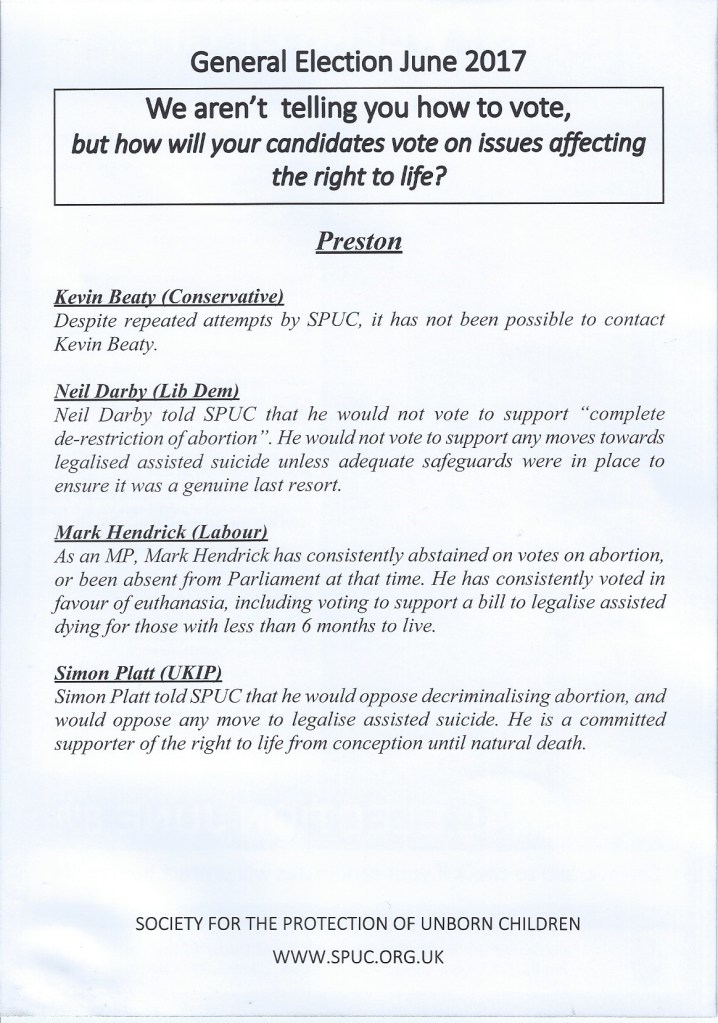
Simon Platt is the pro-life candidate in Preston

At every general election, volunteers from the Society for the Protection of Unborn Children seek to interview candidates about their voting intentions on pro-life issues and inform voters about their candidates’ views. A few minutes ago, on returning home after an appointment with a constituent, I found the following leaflet among the mail in my hall:

spuc_leaflet_frontspuc_leaflet_back

I am glad to reaffirm my commitment to the pro-life cause.

You can also see my voting intentions on pro-life issues at Where Do They Stand. (Green indicates a pro-life response. At the time of writing none of the other candidates for Preston have offered responses; you can ask them via the find a candidate page.)

I have also (today, coincidentally) replied to an enquiry from We’re All Equal. They asked

Would you vote in support of a Bill, similar to Lord Shinkwin’s Abortion (Disability Equality) Bill, that would seek to remove section 1(1)(d) from the 1967 Abortion Act?

I replied

If elected I would vote in support of a bill similar to Lord Shinkwin’s Abortion (Disability Equality) Bill. I would make it a high priority. Abortion is a terrible thing, and the eugenic discrimination against disabled children enshrined in the 1967 Abortion Act is a doubly damning indictment of our society’s failure to protect the weakest among us. Lord Shinkwin’s campaign to protect disabled children in the womb is inspiring and I support it wholeheartedly.

Vote Local

All through this election campaign I have been telling people that whatever happens in Preston will not change the government, and that they should therefore “vote local”. Theresa May has called this election to secure her position as Prime Minister and, I hope, to strengthen her position in Brexit negotiations with our European neighbours. On June the 9th we shall still have a Conservative government led by Theresa May, probably with an increased majority. Nothing Prestonians do can change that.

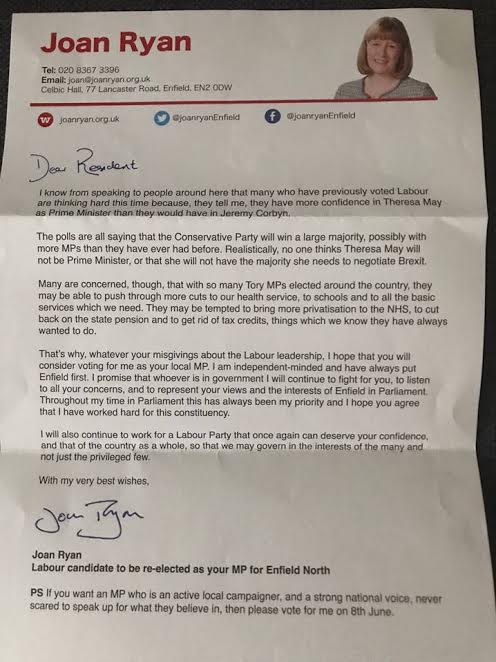
Don’t believe me? Perhaps you’ll believe this Labour Party candidate, and sitting MP, for Enfield North, a constituency in London:

“… no one thinks Theresa May will not be Prime Minister, or that she will not have the majority she needs to negotiate Brexit.”

joan-ryan-letter
Letter from Joan Ryan (Labour, Enfield North). Source: order-order.com

To be fair to Joan Ryan, she seems like a good local candidate. “Independent-minded”, she says, unlike our own Mark Hendrick, who does what his Labour Party bosses tell him to do (when he can be bothered to turn up at all – see publicwhip.org.uk). But the main point here is this: in Preston, we are not voting for Theresa May or Jeremy Corbyn to be Prime Minister, we are voting for our local representative.

So vote for the best local candidate. That candidate is me. I am the only Prestonian among the five candidates; the only one with parents, grandparents, great-grandparents from Preston (I’m sorry I don’t know about the fourth generation); the only one with children born and raised in Preston, the only one with a long-term, intergenerational interest in Preston, the only one for whom Preston is more than just a means to an end, a means to a political career.

Vote for the only candidate who really cares about Preston, its people, its future. Vote Platt for Preston.

My message in the Lancashire Post

All the Preston candidates were given the opportunity to submit a 100-word statement for publication in last Tuesday’s Evening Post (I learned that even staff at the paper haven’t got used to calling it the “Lancashire Post”, so I don’t feel so bad when I call it the Evening Post myself).

Here’s my message:

As a lifelong Prestonian I am proud to be your UKIP candidate. I am passionate about my home city and believe in its bright future in an independent Britain.

Your vote in Preston will not decide who runs the country, but it can make a difference locally. As your MP I will stand up for the things that matter to the people of Preston: not just a successful Brexit, but also better schools, improved health and social care, a secure economy, a stronger community.

That’s why I’m standing for Preston, and that’s why I ask you to vote for me.

You can read the full article on the LEP website.

Leaflet delivery and the Manchester terrorist attack

I’m pleased to be receiving responses, by email and telephone, to my campaign to be Preston’s next MP. I had had several, mostly supportive and some asking for help with local problems, which help I’m trying to give. But I have also had one, polite, letter of criticism from a voter who thought my campaign team should not have been delivering leaflets on Tuesday, the day after the Manchester terrorist attack. He deserved a full reply, which I take the opportunity of posting here, anonymised:

Dear X,

Thank you for your email. I’m sorry you’re unhappy, but I’m glad you got in touch. I know it can be tricky to write a letter of complaint, and you deserve a proper answer.

There are two leaflets that have been delivered on my behalf this week.

One is an election communication being delivered by Royal Mail. Every house in Preston constituency will have received one by early next week. That delivery is not under my control. Some will have been delivered on Tuesday.

But I think you probably mean the other leaflet, which is my letter to postal voters. That is being delivered by a team of volunteers working on my behalf. Here is what happened.

I am currently away on business, in China. It’s unfortunate that this comes during the election campaign, but I had a professional commitment here which I needed to keep. I arrived here on Tuesday evening (Chinese time, Tuesday morning in England) to hear about the terrorist attack in Manchester. When I checked my email later I learned, via an email from the UKIP leader, Paul Nuttall, that campaigning had been suspended for the day.

In the meantime, my volunteers had responded differently to the call for campaigning to be suspended. Even though delivery of the letter to postal voters was urgent, some had decided that they must not deliver any on Tuesday, because they considered that to be “campaigning”. That’s obviously your view, too. Others took a different view, taking “campaigning” to mean something more narrowly defined. On Tuesday I asked my agent to find out, and in the meantime I sent this message to my leafletters by email:

“Thank you for delivering letters to postal voters on my behalf.

As you know our target was to complete this by the end of tomorrow, Wednesday, so that my message to postal voters reaches them before their postal votes packs arrive on Thursday. I know that deliveries to some wards had been completed by yesterday and that good progress has been made elsewhere. Thank you.

And then, overnight, there was this massacre in Manchester. I’m on business overseas as I write and so I don’t have easy access to British news, but I know that the election campaign has been suspended for today, Tuesday, by UKIP and I think by other parties, too. I also understand that there is some uncertainty about what is meant by “campaigning” – whether or not it includes delivering leaflets, or whether it is limited to things like TV appearances, set-piece speeches, etc. Kieran, as my agent, is finding out about that. And, so, some of you tell me that you have stopped delivering; others that you are carrying on.

This email is to let you know that I am happy and will support you in whatever decision you have made. I know you’ll try your best to complete your delivery rounds by the end of tomorrow; please don’t feel bad if you have to finish the job on Thursday.”

The advice given to my leafletters later on Tuesday was as follows:

“In reference to campaigning, please do continue to deliver leaflets. But refrain from any social media campaigning, and please do not door knock. Engage with the public if necessary but don’t wear your rosettes out on the streets.”

I’m still not sure what is the right thing to have done, but that is the advice that was given to my leafletters and I am happy to stand by their individual decisions because I think they were all made in good faith. There certainly should not have been any canvassing and I don’t think there will have been – we were not planning to do any canvassing this week because our priority was to deliver letters to postal voters.

I understand that campaigning has resumed in earnest now, although I also heard that there was a minutes’ silence today.

Once again I’m sorry that you were unhappy with the approach taken by the deliverers in your area. I’m willing to be held responsible for that but I can assure you that my leafletters and I take this business of the Manchester bombing very seriously indeed.

It’s useful to have feedback, and your email has prompted me to put an anonymised version of my reply on my blog, Standing Up (ukippreston.wordpress.com).

Simon’s message to postal voters

Dear resident,

Your postal voting pack will arrive soon. You can help me change the course of the country. Together we really can make a difference.

Please vote for me to be your next MP. You will be voting for a Proud Prestonian who knows Preston well and who cares for Preston and for Britain. I believe in a prosperous future for my home town and my country. Like most Prestonians I supported Brexit in last year’s historic referendum. I am the only candidate in Preston who has always believed that Britain has a brighter future as an independent country.

Only a vote for me, your local UKIP candidate, is an unambiguous vote of confidence in Britain’s future outside the EU. UKIP say we should not pay to leave the EU and should not continue to pay the EU after we have left. We should control our own fishing waters. We should be able to control immigration from the EU. We should begin trade negotiations as an independent country. Did you know that in April Labour, Conservative and Liberal Democrat MEPs voted against these proposals? That’s right – they voted against the clear national interest! (Source: http://www.europarl.europa.eu/plenary/en/votes.html)

We shall have a Conservative government after the 8th of June, probably with an increased majority. Nothing that happens in Preston will change that. As your MP I will support that government when it acts in the national interest and oppose it, vigorously, when it acts against the interests of Britain and of Preston.

And this election is not just about Brexit. Conservative, coalition and Labour governments have served Preston poorly. Young people are being let down. Adult social care and the NHS are in crisis. Police stations and post offices are closing. Fulwood Barracks is closing. Our defence industry is not valued enough. Our energy bills are artificially high. All this is due to the policies of the three old parties. UKIP opposes these policies, and I oppose them. We stand for revitalisation: of trade, of education, of defence. We stand for security: secure borders, secure energy supply, security of strategic industries. We stand for community, for local empowerment, for democracy. That’s why I’m standing for Preston, and that’s why I ask you to vote for me.

Yours faithfully,

Simon Platt

Simon Platt’s message to Preston’s voters

As a Proud Prestonian I am delighted and excited to have been chosen to be UKIP’s candidate for Preston in the forthcoming general election. Preston has lacked adequate representation in parliament for many years, and I will change that.

Only UKIP is unequivocally committed to independence for the UK. Voting for me will put pressure on the government to fulfil its promise to respect the wishes of the British people, democratically expressed in last year’s historic referendum.

But Brexit is only part of the picture. Preston has been very badly served by Labour, coalition and Conservative governments for generations, especially in defence and education. Preston needs a new voice to stand up for its interests and the country’s. That voice is mine.

Free speech

I think UKIP has a reputation for standing up for free speech (our leaflets are often headlined “straight talking”, after all). So I was very interested to read a statement from Colin Hart, of The Christian Institute, expressing concern about Conservative Party plans for a “Commission for Countering Extremism”, as revealed in their manifesto this week. I agree with Colin, and make his words my own. He says, among other things:

“The word ‘extremist’ has been robbed of all meaning by activists who use it against anyone who disagrees with them. We’ve already seen a series of witch-hunts against people with traditional views.

“This Commission on extremism might make a bad situation a whole lot worse.

“People labelled extremists in their own day include Martin Luther King, Rosa Parks, Harriet Beecher Stowe, William Wilberforce and the Tolpuddle Martyrs.

“Today, people like Germaine Greer and Dame Jenni Murray are vilified for ‘extreme’ views on transsexualism that actually represent the views of the great majority of people.”

via Tory extremism manifesto pledge ‘a risk to civil liberty’ – The Christian InstituteThe Christian Institute